

The white bird set for a big future?'
Published on : 22 Jul 2026
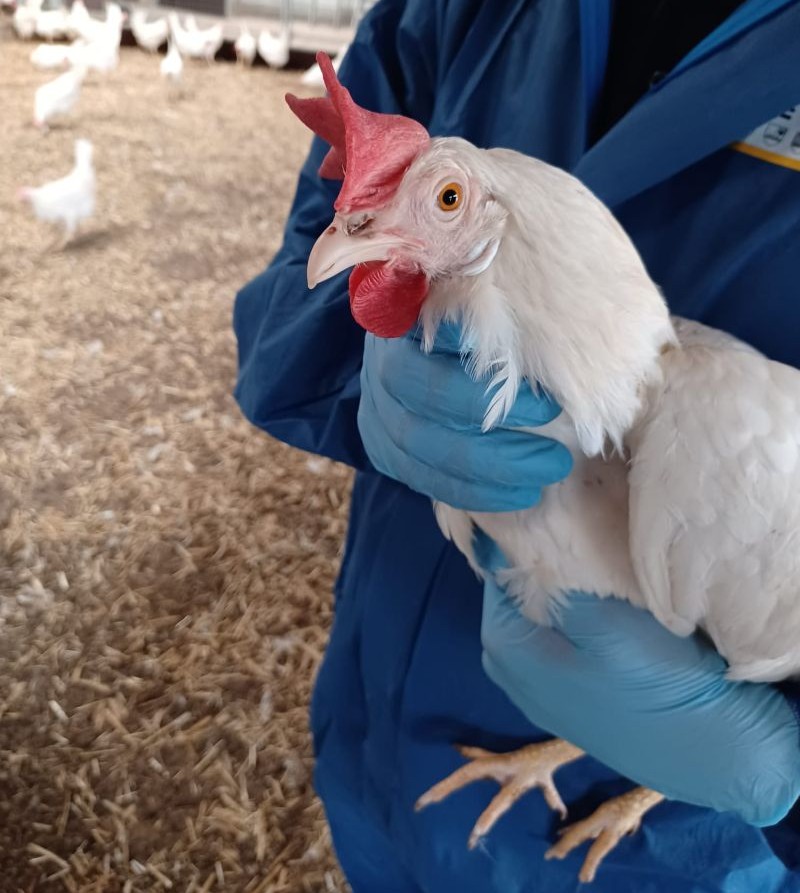 BFREPA chairman James Baxter and head of producer engagement and strategy Gary Ford travelled to Germany with fellow board member Andrew Baxter to see the Lohmann LSL Lite EU in commercial production, visiting two free-range units alongside Lohmann GB's David Wilson and Lisa Nemeding of Lohmann Deutschland. The breed was introduced in Germany in October 2021, and the first Lite EU birds have now been placed in the UK, housed in a barn system.Lohmann GB brought the LSL Lite EU into Britain and Ireland in the spring, adding a second white option alongside the established LSL Classic. The German trip was arranged to see what several years of on-farm experience there actually looks like ahead of the breed's UK debut. The breed was developed for a European market where egg size mattered less than egg numbers, while keeping the shell quality Lohmann's white birds are known for late in lay. Egg weight on the Lite EU can be managed within a range, giving producers the option of pushing for numbers on an all-egg contract or for size on a graded contract.The two farms gave a useful contrast: different scales, different housing and litter arrangements, different points in the laying cycle, but a consistent picture from both producers of how the Lite EU is performing for them.First farm: 22,500 layers, week 36, free rangeThe first farm visit was a 22,500-bird free range unit, with the birds aged 36 weeks, laying at 98% (breed standard 97.5%) with an average egg weight of 58g (breed standard 59.0g). Asked to compare the Lite EU with the LSL Classic, the producer's view was that mortality runs lower on the Lite EU, put down to a reduced propensity for smothering and, in his words, a more robust bird generally. Feather cover held up well too, with flocks on the farm reaching 100 weeks still in good condition.What struck the visiting party most was temperament. The birds seemed more social and inquisitive than they expected from a white layer, though not quite to the level of a brown bird. Combs were less pronounced, though these were still young birds whose combs had some developing left to do, and the overall appearance of the bird looked closer to a brown layer's than a typical white layer. Drinkers on this shed were fitted with two-legged drip cups.Standard body weight for the breed at 36 weeks is 1,662g, but the flock on this site was running heavier, at 1,840g — for context, a Lohmann Brown at the same stage would be around 1,880g. Feed tells a similar story: breed standard daily intake is quoted at 118-120g, and this flock was averaging 112-115g, slightly under standard despite the extra weight the birds were carrying. The producer put the shortfall down to occasional dips in the feeding chain rather than anything happening day to day — intake here is tracked weekly rather than daily.Depopulation is planned at 100 weeks, described as comfortably achievable, with some German producers already pushing to 110-115 weeks. Laying rate on a typical flock at 100 weeks was put at around 85%, though some producers run flocks closer to 80% because the economics still stack up for them at that point — well above the breed guide figure of 70.2% at 100 weeks. A flock with 5-6% mortality by 100 weeks was considered to be a good result.Birds on this farm had come from Lohmann's own pullet-rearing operation ten kilometres away, arriving at 17 weeks. This is standard practice in Germany and the Netherlands, where the breed company typically owns the rearing farm as well as the hatchery. Salmonella vaccination is given by injection at 14 weeks, leaving three weeks for immunity to build before the birds are delivered. Where a customer has a particular salmonella concern this can be doubled up with a second needle vaccination and reinforced with three or four water vaccinations against Salmonella Typhimurium and Enteritidis — something that matters more on farms that also keep pigs. There is discussion in Germany of vaccinating against salmonella again during lay, though this was described as a developing idea rather than settled practice.Newcastle Disease vaccination is compulsory under German law and given in rear. The method has recently shifted away from drinking water, used for the previous 40-50 years, to eye and nose administration, a change driven by disease concerns in Poland and Germany rather than any change to the legal requirement itself. IB vaccination is also given in rear, varying by farm, alongside a spray-administered vaccine. Beak treatment isn't permitted in Germany. In-ovo sexing is used at the hatchery, with fewer than 1% of male chicks reaching the rearing farm and a stated accuracy of over 99.5% in removing males before delivery.Feed formulation threw up one of the more striking differences from UK practice. Meat and bone meal is permitted in German rations for both pullets and layers, provided there's no cross-species feeding — birds can't be fed meat and bone meal in their ration if pigs or sheep are also kept on the same farm, to avoid cross-contamination and preserve traceability. It isn't standard practice across German farms generally, but where it has been used, no issues were reported in birds moving from a meat-and-bone-meal ration in rear to a layer farm fed on a 100% vegetarian diet. Some hold the view that managing entire, untrimmed beaks without a flock experiencing injurious feather pecking is only realistic where meat and bone meal is included in the ration.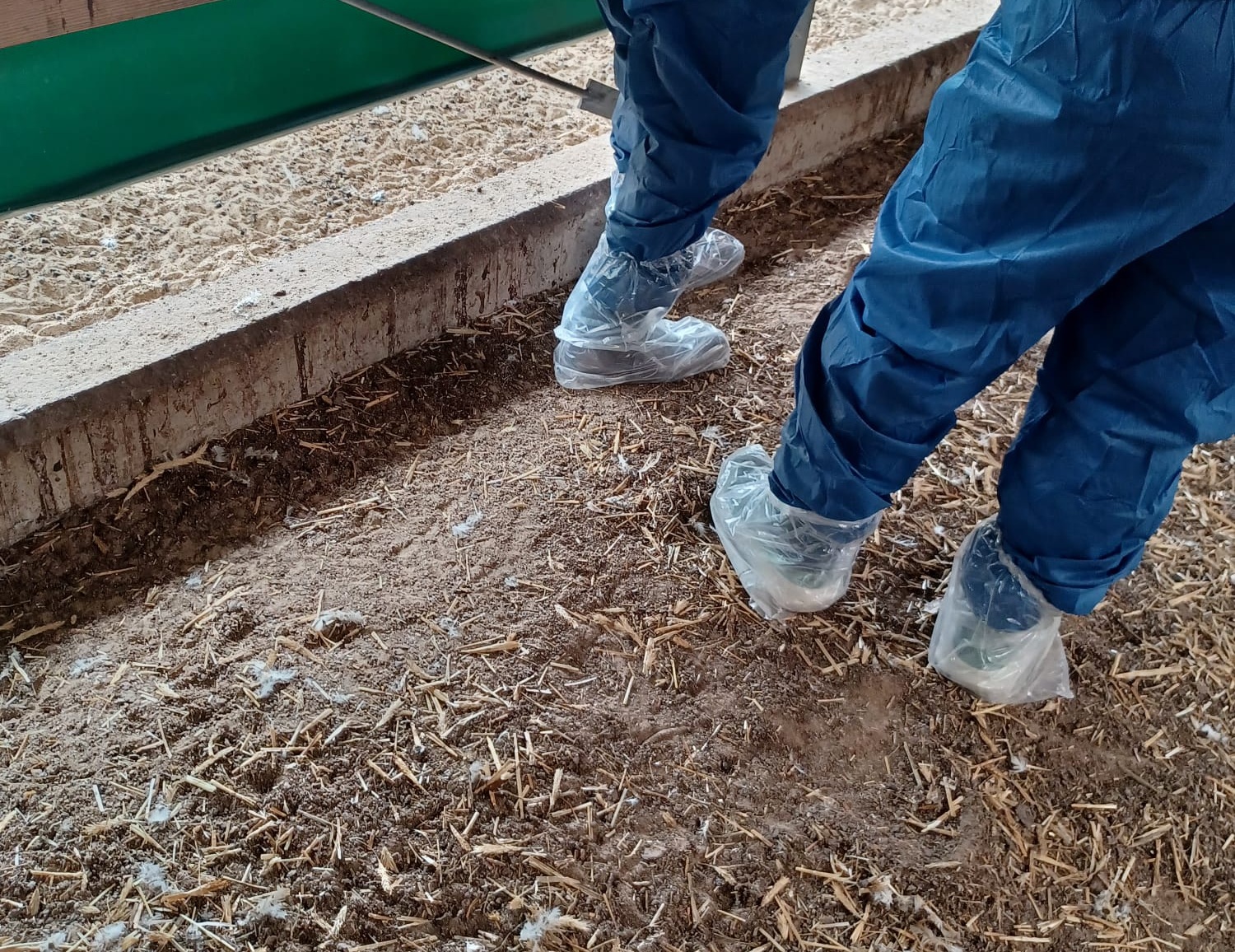
Whilst the litter was generally excellent there was some capping near to the veranda popholes
Worming begins at 28-30 weeks and is repeated every 10-12 weeks, given in the water. Red mite is treated reactively rather than routinely, using Exzolt, and the farm would expect to treat at least once per flock as a minimum, typically in summer, with two treatments about a week apart. Some producers bring in a contractor to heat-treat sheds at turnaround specifically to deal with red mite, though this farm doesn't use that approach; heat treatment here is reserved for salmonella problems rather than used as a standard part of the turnaround.Litter is predominantly fine wood shavings or sawdust rather than straw. Lucerne and pecking blocks are provided in rear and carried through to the laying farm to keep enrichment consistent across both stages, though birds are kept without pecking substrate for the first five days after arrival so they learn to find the feed chain before enrichment goes in. Sheds include a veranda-style winter garden, with drinkers kept out of it so birds drink only within the main shed. Windows have to make up 5% of floor area under the KAT standard.Second farm: 36,000 layers, week 30, free rangeThe second farm was a bigger operation: 36,000 birds at 30 weeks, split across colonies within the shed — permitted under German rules, where colony size rather than overall shed size is the limiting factor. Lohmann's largest free-range farm holds 50,000 birds in a single shed, divided into colonies of 6,000-8,000 birds each; organic sheds, by contrast, are capped much lower.Eggs from this farm go out on a flat-price, all-egg contract — the same rate regardless of size, provided eggs are at least 53g, with no premium for producers whose birds lay larger. It's a useful point of contrast with how UK contracts are typically structured.
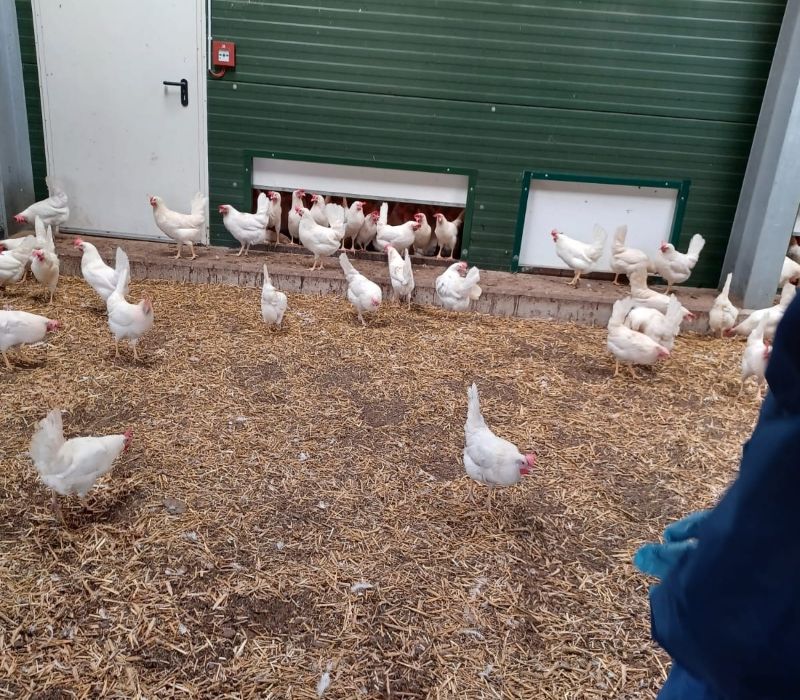
Straw was used as an enrichment at the second farm visit.
This was the farm's second flock on the Lite EU, and the producer was clearly pleased with both flocks. Feather cover was described as very good at the end of lay, and the birds were calm — something the visiting party could see for themselves, with seven people walking through the shed failing to unsettle the flock, even if they didn't crowd around visitors the way brown birds do. The producer's own view was that rearing farm quality, more than genetics, is the single biggest factor in getting a good laying period, and that there's little to choose between the two main white breeds in terms of the eggs themselves.Heat tolerance came up unprompted. During a spell of extreme heat the previous week, with temperatures around 40°C, the producer reported no mortality and no piling in the Lite EU flock — birds settled on the floor and spread out instead.Production figures for week 30 were strong: mortality at 0.36% against a guide of 1.2%, described by the visiting party as very good, and production at 97.9% against a 97.0% target. Feed intake was broadly on target, with a minor dip that week put down to a new feed delivery and a possible blockage or feed-structure issue in the delivery system, still being looked into. The producer tracks all of this on a Lohmann performance template, plotting production against a guide line alongside feed consumption and mortality on a rolling graph — the delegation asked for a blank copy to translate into English for use with UK members.Manure here goes to a biogas plant rather than onto arable land directly, and is stored temporarily in an on-site muck store; wet manure, partly the result of water spilling from the drinker cups onto the belts, meant a fair number of flies around the store. On drinker design, the producer felt a twin-leg drip cup made little practical difference to bird access and said he actually preferred a combined cup-and-umbrella style; the visiting party noted that UK advice tends to favour two-legged cups for white layers.Range and veranda access opens at 10:00 on this farm, though the exact timing depends on shed layout and region. The veranda had roof lights fitted, and asked whether he'd install them again, the producer said he would — but he'd site them further away from the layer shed, since daylight streaming in through the open vents in the current arrangement made light control inside the shed harder than it needed to be. Windows were fitted as part of the KAT scheme but are often kept closed in practice.Enrichment rules under KAT count litter itself as one recognised form, with pecking stones as a second; straw and lucerne were also present, though used out in the veranda rather than in the main shed. That's a genuine point of difference from the UK, where litter doesn't count toward the enrichment requirement and producers must provide one destructible material, such as lucerne, and one non-destructible material, such as plastic. Bell drinkers are used in the veranda only briefly when young birds are first placed, and the producer avoids them afterwards, preferring birds to drink from the main drinker line inside the shed rather than out on the veranda.
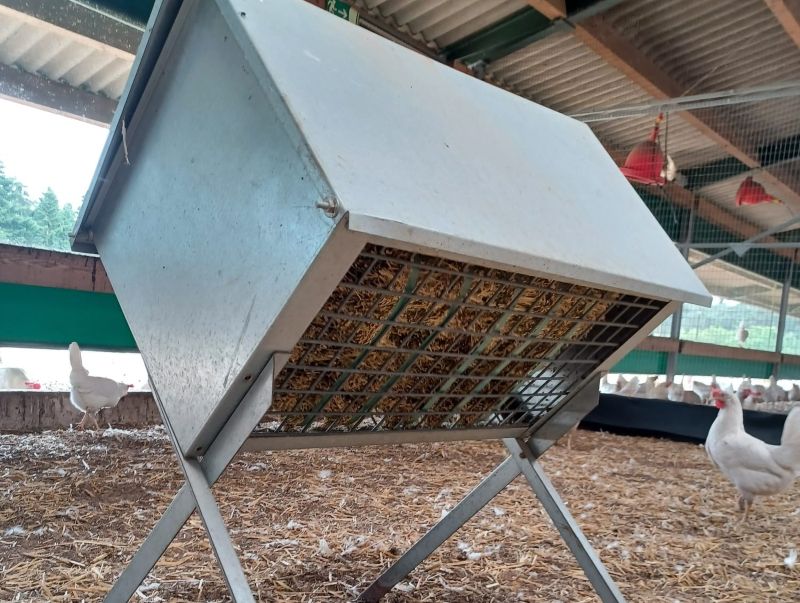
On the second farm, lucerne bales are provided in hoppers in the veranda.
On vaccination, water-based vaccination is given in week 65. Newcastle Disease vaccination is given via drinking water every six weeks, a response to ND pressure currently being seen in Poland and Germany, with IB vaccination also given every six weeks, alternating with ND on a three-week cycle.Red mite is treated once a year using Exzolt, applied as two doses roughly a week apart, timed for the hottest part of summer when the mite's life cycle is shortest and a single treatment window stands the best chance of catching the whole population. No antibiotic treatment had been needed for this flock, which he said was typical rather than exceptional.What's used on the range here isn't litter in the conventional sense but ordinary building sand, spread on the ground immediately outside the popholes. Fresh sand goes over the old for each new flock rather than the old material being removed, and it's topped up once or twice a year depending on how much the birds ingest — some sand loss to consumption is considered normal rather than a problem. In wetter parts of Germany some producers disinfect the sand with lime; a few use stone instead, though this producer felt stone was harder to keep clean and more likely to harbour disease.Lights come on at 06:30, with the first feed run five minutes later; feed runs six times a day, with the first few runs close enough together to act as one extended feed, followed by a four-hour break. The plan is to move this flock onto split feeding once it's past peak production — the producer described it as an effective tool, but one that demands close attention, since it can go badly wrong if it isn't managed properly. Every 10-12 weeks the flock also gets a "fatty liver" feed mix, designed to protect birds from excess liver fat during high-production periods on a rich diet; farms running split feeding need this less often. It was noted that the feed was coarser and contained a higher level of fibre, achieved by feeding oats in the ration and using a roller rather than hammer-milled feed. This was felt to be a key element in managing entire beaked birds, as it was believed that the birds could more easily clear the feed trough (fewer fine particles) and the fibre provided "gut fill" which kept the hens satisfied and less prone to feather pecking. UK feed, by comparison, is almost all hammer-milled.A small amount of comb pecking had been seen in this flock by the producer, but it stopped as suddenly as it started and hasn't recurred — possibly put down to the stress of transport and a new environment rather than anything ongoing. The all-egg supply contract allows for up to around 5% Class B eggs — floor eggs, dirt, or machine-graded seconds — before a lower price is paid. Class B volumes tend to rise as a flock ages. On the day of the visit, with lay at 97.9%, a few hundred eggs a day were going to Class B, described as normal for a white-egg flock at this stage. The producer hadn't fixed a depopulation age for this flock, saying it would depend on when his rearing supplier has the next batch of point-of-lay birds ready, with keeping birds to around 100 weeks described as entirely feasible.What the two visits have in commonBoth producers were positive about the Lite EU's temperament and its handling of heat stress, with feather cover and mortality that both regarded as a genuine improvement over the earlier LSL Lite rather than a marginal one. Both are working toward a 100-week cycle as a practical target rather than an aspiration.KAT rules that treat litter itself as recognised enrichment, a more active vaccination programme against Newcastle Disease and salmonella than currently required in the UK, and feed and litter choices — sand systems, coarser, rolled, higher-fibre rations — are shaped as much by regulation as by farming philosophy. On both farms, pullets were reared by the breed company itself before being moved to the layer farm at 17 weeks, a structural difference from the UK's more fragmented rearing sector. Both visits pointed to a wider pattern in German production which the BFREPA team felt it was important that members were made aware of.