

No country measures egg consumption directly, WEO economist warns
Published on : 24 Sep 2026

Peter van Horne
Egg consumption rose in 30 of the 35 countries reporting to the World Egg Organisation last year, but the figures behind that growth are calculated rather than measured and should not be used to rank one country against another, the WEO's economist Peter van Horne told its conference in Singapore.No country in the world measures how many eggs its people actually eat, Peter van Horne told delegates at the World Egg Organisation's conference in Singapore on 9 September, and every consumption figure published, from Mexico's world-leading 410 eggs a head to the UK's 209, is the product of a calculation that each country carries out in its own way.The poultry economist, who normally presents on the cost of cage-free conversion, avian influenza and in-ovo sexing, said it made a change to bring the industry positive news. Consumption increased in 30 of the 35 countries that supplied data for 2025, and the world average has climbed to 191 eggs per person a year from 186 when he last reported it, based on FAO production of 93.7 million tonnes in 2024 spread across 8.16 billion people.He said the world average is the one figure free of the complications of trade, because imports and exports cancel each other out globally, but converting tonnes into eggs still meant choosing an average weight, and he used 60g whilst accepting the point was open to debate, with the average egg weighing 62g in Europe and 60g in the United States.National consumption is worked out as an egg equivalent balance, taking domestic production, adding imports of shell eggs and egg products, subtracting exports and dividing what remains by the population, Mr van Horne explained. The method is common to almost every country, he said, but it is applied very differently from one to the next, which is why the trend within a country can be relied on whilst comparisons between them need care. "The trend within a country is okay, but in between countries, be careful," he said.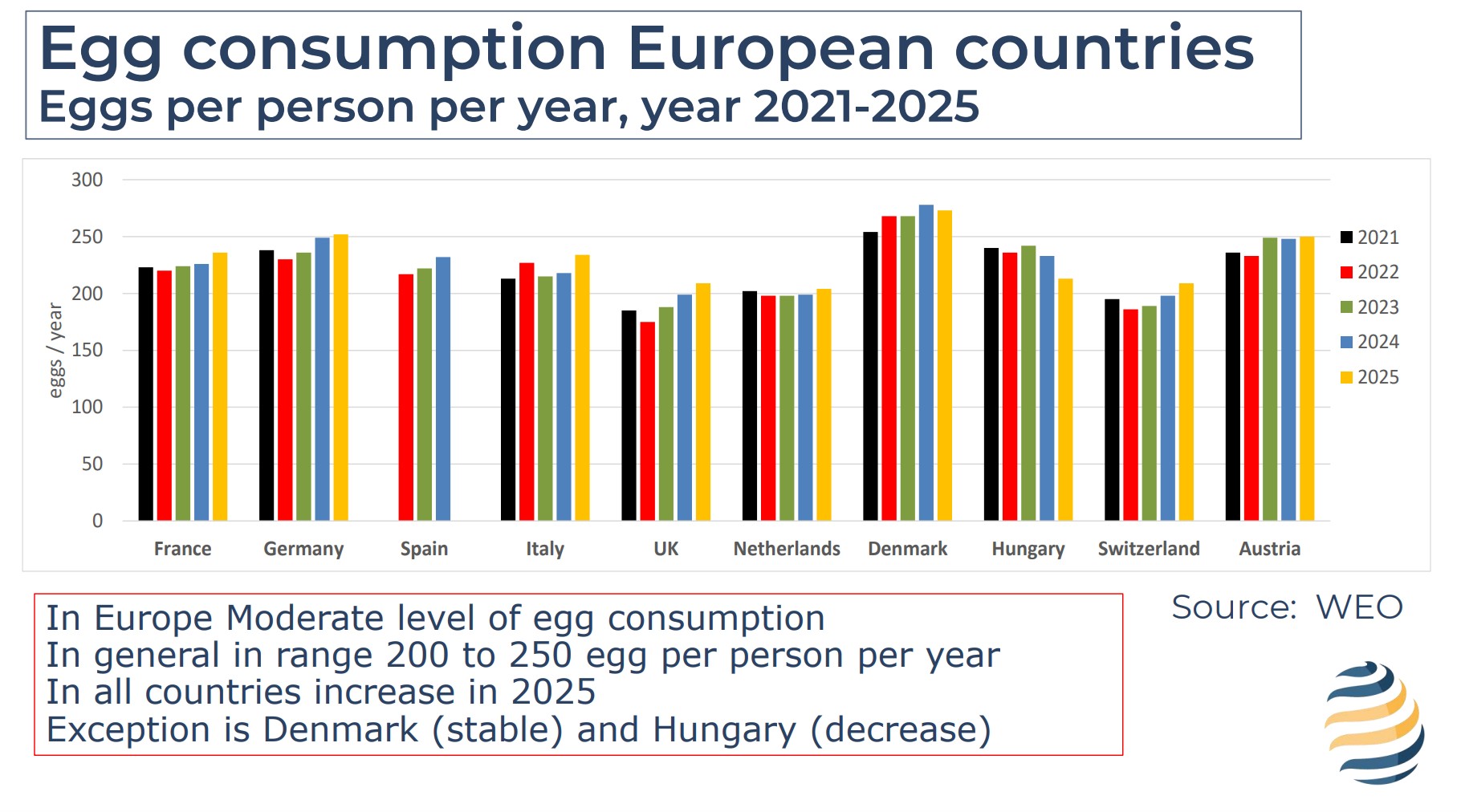
The UK is amongst the lowest consumers of eggs in Europe
German production, which he used as a worked example, is not counted but estimated from hen numbers multiplied by a standard rate of lay, which gave 15,279 million eggs in 2025, and a flat 1 per cent is then deducted for losses. Germany is a heavy importer, bringing in 5,580 million shell eggs and the equivalent of 2,450 million more as egg products, whilst exporting 1,270 million shell eggs and 875 million egg equivalents, and only after all of that does the German balance arrive at total use of 21,010 million eggs and consumption of 252 per person. He said the volume of statistics feeding that figure makes the result very sensitive.He said some countries deduct 1 per cent for losses between farm and end use and others make no deduction at all, some include hatching eggs, which he said is often the case in FAO data and has to be corrected for, and many leave out backyard flocks altogether. The conversion of egg products back into shell egg equivalents is a further source of variation, as is the egg weight used to turn tonnes into numbers.Mr van Horne said that when he asked the Egg Industry Center in Iowa and United Egg Producers why US consumption was falling, he was told the drop followed avian influenza, which had cut production and led to the culling of 40 million layers, and was asked to stop calling it consumption. "Peter, please don't talk about egg consumption. It's disappearance," he said he was told. The US calculation takes production, imports, exports and the change in inventory and divides the result by the population, and on that basis the figure has fallen from around 284 eggs a head in 2021 to around 263 in 2025.Consumption covers shell eggs, food service and egg products together, he said, and in Europe, the United States and Canada he estimated shell eggs at 60 to 65 per cent of the total, food service at 15 to 20 per cent and egg products at 20 to 25 per cent. The egg products share is far lower elsewhere, at 2 to 10 per cent in South America and Mexico, 2 to 5 per cent in Asia and 1 per cent in South Africa, against 15 to 20 per cent in the UK, and he said he hoped the national rapporteurs supplying the data understood what they should be including.Mr van Horne said he would like to see more household panel and supermarket scan data, which measure purchases directly but only at retail level, pointing to YouGov's panel of 6,000 Dutch households reporting their egg purchases and to scan data from Circana (IRI) and Nielsen. In the Netherlands supermarket egg sales rose 4 per cent last year, he said, which gives a useful signal, but with shell eggs making up only 60 to 65 per cent of the total in Europe such sources can never give the full picture.EuropeEurope sits in the moderate range of 200 to 250 eggs per person a year, and consumption rose in 2025 in every European country Mr van Horne presented with the exception of Denmark and Hungary.Germany led the increases among the larger markets, reaching 252 eggs per person from 234 in 2022, with Austria close behind at around 250 and France and Italy both at around 235. The Netherlands, which had been flat at around 200 for several years, grew by 4 per cent on his own calculation, and Switzerland rose to around 209.The UK remains towards the bottom of the European group but has now increased for three years in succession, from a low of around 175 eggs per person in 2022 to around 188 in 2023, around 199 in 2024 and around 209 in 2025.Denmark still has the highest consumption in Europe at around 273 eggs a head, but its figures showed a slight fall from around 278 in 2024, and Mr van Horne said the Danes wanted to be different all the time. Hungary's decline was sharper, from around 242 in 2023 to around 213 in 2025, and he had no explanation for it. "Hungary, I don't know what's going on," he said.Spain did not supply a 2025 figure, and he said the country is always difficult to calculate because consumption has to be corrected for the number of tourists eating there. Belgium does not report at all, which he put down to the country having four ministries of agriculture, and there are no figures from the Czech Republic or Sweden.Gaps in the dataThe WEO database is built from rapporteurs in 37 countries across Europe, the Americas, Asia, Australia, New Zealand and South Africa, and Mr van Horne said it should not be read as a worldwide picture. There are no figures for Singapore, Malaysia or Indonesia, which he described as important egg producers, nor for Turkiye, most of the Middle East or most of Africa, and China, with 1,366 million layers, had not yet submitted its 2025 figure because, he said, it was still counting. "Please keep me busy working with the data. I need more numbers, more data," he said.Where consumption is highestThe highest consumption in the world is in Mexico, Argentina and Colombia, all above 300 eggs per person, which he described as "one big success story". Mexico reached around 410 eggs a head in 2025 and Argentina climbed from just under 300 in 2021 to close to 400, with Colombia rising to around 365. He put the region's appetite for eggs down to culinary tradition, affordability, a large domestic industry keeping prices low, and a government and public health message encouraging people to eat them.In East Asia, Japan was stable at around 327 eggs per person, South Korea rose to around 296 and China was at around 291 in 2024. Canada and Australia were both at around 270, and India, whilst still at a low level of around 89, is increasing. Mr van Horne said India's population of 1,470 million makes even small gains there worth far more in volume than larger gains in smaller markets. "I prefer an increase in consumption of two eggs in India instead of an increase of 20 eggs in Canada," he said.Plotting WEO consumption against World Bank income figures, he found no clear link once a country's gross national income passes around US$15,000 per person, with Europe, North America, Australia and New Zealand spread between 150 and 300 eggs a head regardless of wealth, and Norway and Switzerland, both close to US$100,000, at around 223 and around 198. "I would say income is not a factor," he said.Adding countries from Rabobank and national statistics, he showed the lowest consumption concentrated in Africa and Asia among countries with incomes below US$10,000, from 130 eggs a head in Morocco and 106 in South Africa to 45 in Nigeria, 40 in Tanzania and 20 in Ghana. He said income could have some influence at that level, but repeated his warning about the data and said more figures would be needed before the link could be called significant.