
Longer laying cycles drive Elanco’s in-lay Salmonella vaccine breakthrough
Published on : 4 Jul 2026
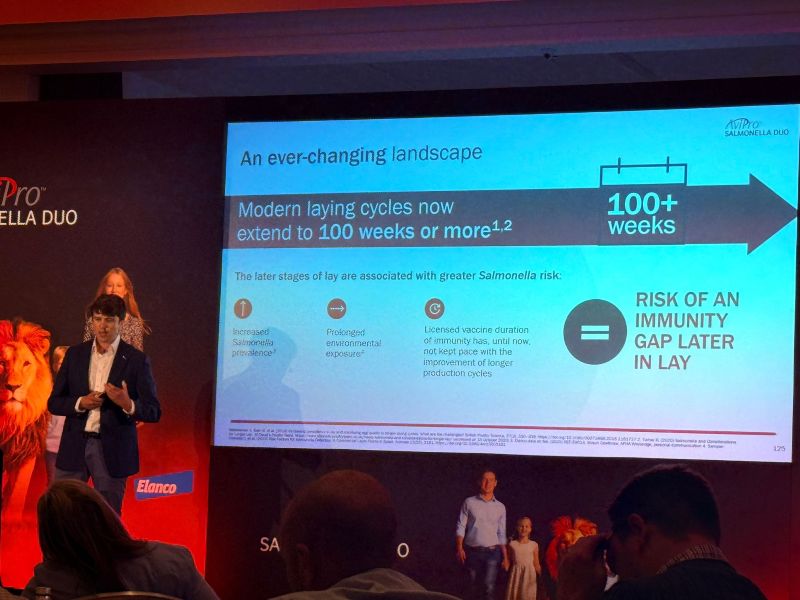
 Elanco has secured a UK licence extension for AviPro Salmonella Duo that allows the vaccine to be used during the later stages of a laying cycle, closing what the company describes as a growing “immunity gap” in flocks that are now living, and laying, for far longer than the vaccine’s original duration-of-immunity data was designed to cover.The new in-lay indication was the centrepiece of an Elanco stakeholder event held to mark 25 years since the company’s first UK-licensed live Salmonella vaccine, AviPro Salmonella Vac E, reached the market in 2001. That launch followed Elanco’s broader shift into animal health during the 1980s, moving away from its earlier focus on plant science, a transition formalised with the creation of Elanco Animal Health in the 1990s. AviPro Salmonella Vac E was followed a year later by AviPro Salmonella Vac T, targeting Salmonella Typhimurium, before the two strains were combined into AviPro Salmonella Duo in 2011 – at the time the first live, dual-strain vaccine able to give simultaneous protection against both serovars regulated under the UK’s National Control Programme. This year’s development means the same product used at rearing can now also be administered as a booster dose in lay, rather than being confined to the pullet shed.Why the industry needed itClosing out the event, Josh Davison, Veterinary Technical Consultant and Marketing Lead for Elanco’s UK and Ireland poultry portfolio, framed the launch against the history of Salmonella control set out earlier in the day: the rise in human salmonellosis cases through the 1980s and 90s, the introduction of the Lion Egg Scheme and mandatory layer vaccination in 1998, and the dramatic fall in cases that followed. The risk from UK eggs is now officially described as “very low” – but Davison was careful to stress that low is not zero. The most recent full-year figures cited during the event recorded seven positive Salmonella Typhimurium results and two positive Salmonella Enteritidis results, and Davison argued that an industry approaching the point of diminishing returns should still take up any tool capable of reducing that residual risk further.The case for doing so, as set out in Elanco’s presentation, rests on a straightforward mismatch: modern laying cycles now routinely extend beyond 100 weeks, but the licensed duration of immunity for existing Salmonella vaccines has not kept pace with that shift. Longer cycles mean increased Salmonella prevalence, prolonged environmental exposure, and – critically – a widening window late in lay during which birds’ vaccine-derived immunity may have waned before the flock is depopulated. Elanco’s slides characterised the consequence as a straight equation: a longer laying cycle plus an unchanged duration of immunity equals a risk of an immunity gap later in lay, which in turn threatens food safety, consumer health and the reputation of the UK egg industry – hence, in the company’s framing, a need to extend layer protection for Salmonella.How the extended schedule works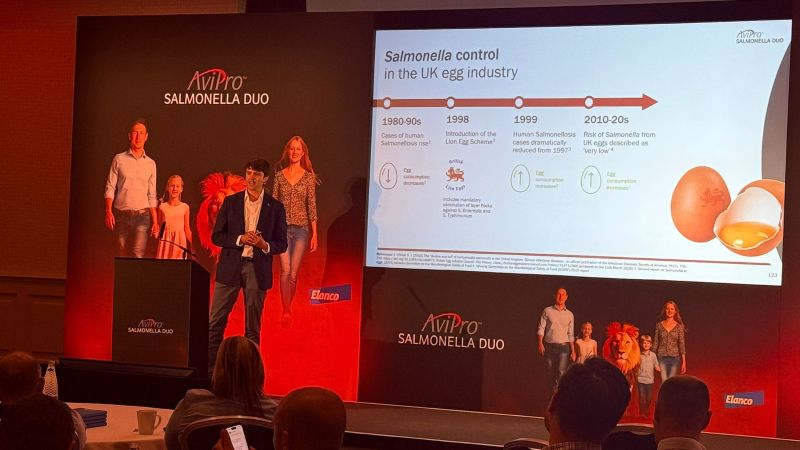
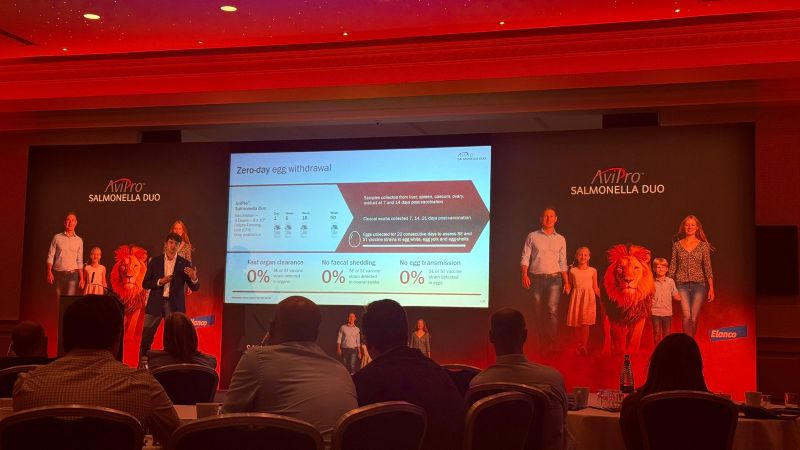
The rearing programme itself is unchanged: a first dose from day one of life, followed by further doses at six to eight weeks and 16 weeks, all administered in drinking water, with Elanco recommending vaccination as early as practicably possible. The innovation is a fourth dose given in lay, “around” week 50 – the Lion Code stipulates weeks 49-51 – a deliberately flexible timepoint intended, according to Davison, to allow pragmatic use on farm rather than a rigid administration date. Trial data presented showed this in-lay booster extending protection to 94 weeks of age for Salmonella Typhimurium and 100 weeks for Salmonella Enteritidis – or 44 and 50 weeks post-vaccination respectively.Central to the licence is a zero-day egg withdrawal period following that fourth dose. Regulatory studies supporting the licence collected samples from the liver, spleen, caecum, ovary and oviduct at 7 and 14 days post-vaccination, cloacal swabs at 7, 14 and 21 days, and eggs over 22 consecutive days to test for vaccine strain in egg white, yolk and shell. Across all three measures, Elanco reported 0% detection: fast organ clearance, no faecal shedding, and no evidence of egg transmission of the vaccine strains. Davison described this as the key practical strength of the product, since any withdrawal period affecting saleable egg production would represent a significant deterrent to uptake.Elanco also positioned AviPro Salmonella Duo as the only live, dual-strain vaccine offering direct protection against both regulated serovars simultaneously, contrasting it with programmes using two separate products given at different times – which achieve eventual, rather than immediate, direct protection against both strains – and with single-strain Salmonella Enteritidis vaccines, which offer only cross-protection against Typhimurium. Practical selling points highlighted included suitability from day one of life, water administration, the zero-day withdrawal, reduced labour because both strains are given together, and a differentiation test that avoids growth on MSRV media, the standard environmental plating method, reducing false positives during routine testing. Separate vaccination protocols for in-lay and in-rear use, each accessible via a QR code on the day, are being built out alongside further training materials as the in-lay licence rolls out to producers.The Q&ADavison was joined for the Q&A by the full line-up of speakers from the day: Thomas Tiley, Elanco’s Senior Director of International Poultry; Matthias Mangels, Customer Service Leader and Cuxhaven Site Lead at Elanco; Lesley Larkin, Consultant Healthcare Scientist and Epidemiologist at Public Health Scotland; Doris Mueller-Doblies, Elanco’s Global Food Safety Consultant; and Rob Harrison of RH Consultancy. Between them the panel had covered the wider outlook for the poultry sector, the 25-year history of AviPro Salmonella Duo, a one-health perspective on Salmonella’s zoonotic significance, the UK egg sector’s relative position on Salmonella control, and how other in-flock treatments such as de-wormers and Exzolt can interact with live bacterial vaccines.Asked how the risk from Salmonella Enteritidis in the UK might evolve over the next five years, Larkin said existing controls had performed well against endemic strains, but flagged the emergence of a “new European clone” of Salmonella Enteritidis that has already spread through parts of Europe and, in at least one instance, reached the UK. Continued vigilance on biosecurity, traveller hygiene and the risk of transmission from other species – including other farmed animals, humans and even domestic pets – was described as essential, alongside a watching brief on antimicrobial-resistant strains that could prove both hardier and more transmissible.
On the question of why a fourth dose is justified when UK prevalence is already low, Davison argued that “low” still means positive cases occur, and that anything capable of reducing that further should be used given how much longer birds are now living. Larkin added that it is not only birds living longer that matters: an ageing human population – including growing numbers of immunocompromised people and those undergoing cancer treatment – makes continued risk reduction more, not less, important.Mueller-Doblies explained the reasoning behind the week 50 booster timepoint. The original duration-of-immunity data supporting the standard product licence ran to 62 weeks for Typhimurium and 68 weeks for Enteritidis, a six-week gap reflected in the extension trial’s later challenge points of 94 and 100 weeks respectively. Running multiple booster timepoints was considered but ruled impractical: the trial already ran for two years and involved substantial bird numbers and cost, and doubling timepoints would have doubled that burden. A fifth dose, potentially relevant for flocks kept beyond 120 weeks, was discussed but not trialled, and therefore falls outside the current SPC recommendation, which specifies only “around” 50 weeks – something Mueller-Doblies said would ultimately remain a judgement for the prescribing vet and producer.On supply, Mangels described a significant investment in people rather than equipment at Elanco’s Cuxhaven manufacturing site, introducing a shift model and improvements to the freeze-drying (lyophilisation) cycle that have shortened production time and allowed more batches to be run. Staff numbers at the site were roughly doubled from January 2025, a change Mangels acknowledged brought a few months of early disruption before stabilising into significantly higher output. Tiley added that a further freeze dryer is being installed to add capacity, alongside a larger dose presentation introduced last year that doubles doses per batch. Between the two, Elanco said it now feels confident in its ability to meet UK demand for the next decade or more, while maintaining a buffer given the vaccine’s role in National Control Programme compliance.Looking further ahead, Tiley stressed that industry feedback drives Elanco’s pipeline, crediting producer demand for longer-lasting Salmonella protection with prompting this year’s in-lay launch itself. He pointed to further developments in train, including work targeting additional Salmonella serovars, new application methods, a move into hatchery-stage vaccination, and a new vaccine addressing a currently circulating poultry disease strain due to launch in the UK this year, alongside a separate combination product expected within the next couple of months. The message from the panel was that the market is moving firmly towards prevention, and that vaccines will remain a priority area for Elanco’s UK poultry investment.Elanco closed the event on a straightforward pitch to producers and vets: that when it comes to food safety, trust matters, and that its role is to remain a reliable on-farm partner rather than simply a vaccine supplier. That message was underpinned by the promised expansion of tailored vaccine-use guidance and training referenced throughout the day, alongside further resources for producers working towards optimal Salmonella control as the in-lay licence beds in.