

Extended laying cycles demand a new approach to feeding
Published on : 21 Apr 2026
 Extended laying cycles are reshaping how the industry defines performance, with increasing focus on maintaining persistency, shell quality and efficiency over a longer productive life. Speaking at the WEO Business Conference in Warsaw, Vitor Arantes of Hy Line International set out the nutritional implications of this shift, challenging traditional assumptions around feeding programmes and flock management.At the centre of his argument is a simple point: hens are not machines. While genetic progress has significantly increased laying potential, production remains constrained by biology. The number of follicles available to a hen declines rapidly from embryonic development through to sexual maturity, leaving a finite capacity for lifetime egg production, even if that ceiling continues to move higher with modern breeding.This biological limitation becomes more critical as laying cycles extend. Producing an egg each day is not the primary constraint. The real challenge is maintaining shell quality over time, particularly as egg size increases and birds age. Each egg requires approximately 3000mg of calcium when accounting for shell formation, internal components and losses, placing sustained pressure on the hen’s reserves across the laying cycle.Over the course of a typical cycle, that demand equates to calcium turnover many times greater than the bird’s total reserves, making long term mineral management a key limiting factor. Extended cycles therefore shift the focus from maximising short term output to preserving those reserves and supporting consistent shell formation deep into lay.Despite this, many feeding programmes remain rooted in older production models. The traditional three phase system, based purely on age, was designed for shorter cycles and more predictable performance patterns. While straightforward to implement, it assumes that nutrient requirements follow a fixed trajectory, which increasingly does not reflect the variation seen in modern flocks.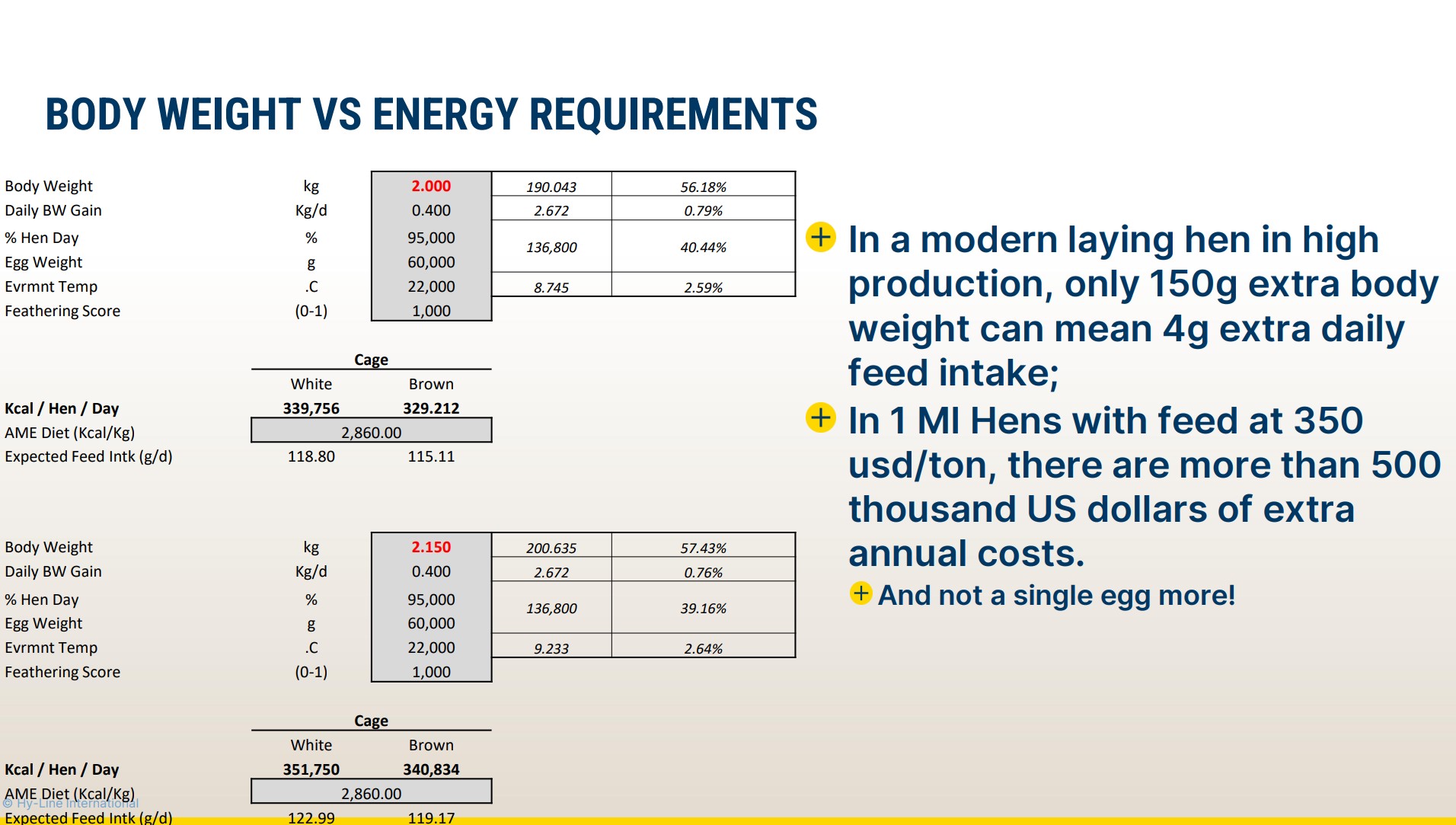
Body weight vs Energy requirements
Data presented during the session highlighted how this mismatch plays out in practice. In high performing flocks, standard feeding guidelines often undersupply nutrients relative to actual production demand. At around 76 weeks, birds may require significantly higher levels of digestible lysine and energy than provided under conventional programmes, limiting production and reducing overall efficiency.In contrast, underperforming flocks frequently receive more nutrients than required. When production drops but feed formulation remains unchanged, excess energy and amino acids are redirected into bodyweight gain and increased egg size. This not only reduces efficiency but also creates downstream challenges, including poorer shell quality, higher mortality risk and reduced laying persistency.The economic implications are substantial. Even small increases in bodyweight translate directly into higher feed intake. An additional 150g per bird can increase daily consumption by around 4g, which at scale represents a significant cost increase without any corresponding gain in egg output.These inefficiencies highlight the limitations of static feeding systems in a dynamic production environment. Arantes argued that feeding strategies need to evolve in line with flock performance, rather than relying on age as the primary driver.A key concept is the use of daily egg mass as a more accurate indicator of nutritional requirement. By combining egg weight and production rate, egg mass reflects the actual output of the bird at any given time. For example, a hen producing a 60g egg at 90 percent lay delivers 54g of egg mass per day, providing a clearer basis for calculating nutrient needs.
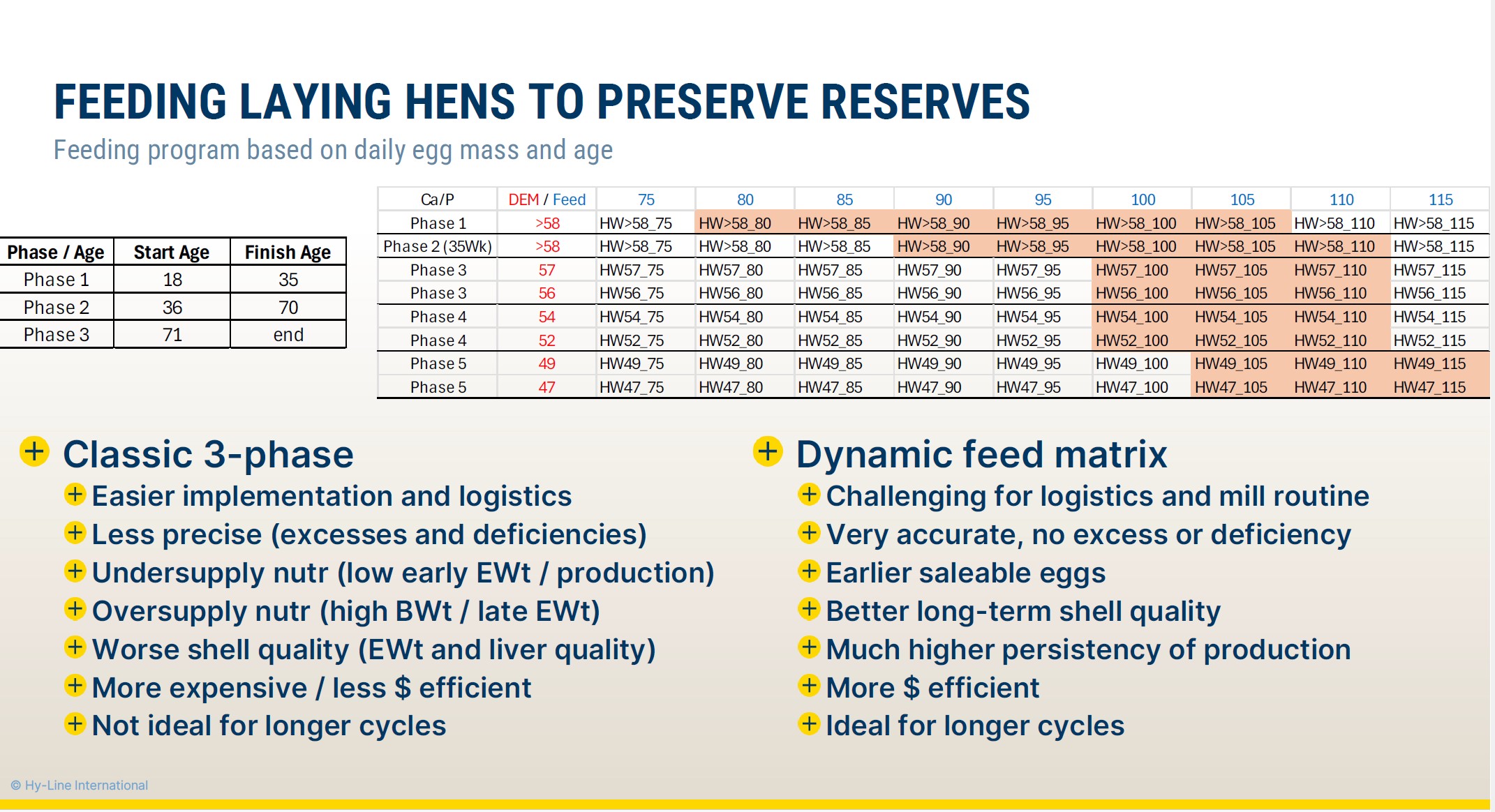
Feeding laying hens to preserve reserves
Building feeding programmes around egg mass allows for more precise adjustments, ensuring that high performing flocks are adequately supported while avoiding oversupply in lower performing groups. This approach can improve early egg size, maintain shell quality later in the cycle and support greater persistency of production.However, the move towards dynamic feeding is not without challenges. More responsive programmes require greater flexibility in feed formulation, increased data monitoring and closer coordination between farm and feed mill. The number of diet variations can increase significantly, adding complexity to logistics and production planning.Even so, the potential benefits are clear. A more accurate match between nutrient supply and demand reduces waste, improves flock uniformity and supports more consistent performance over extended cycles. It also helps avoid the dual risks of underfeeding high performing birds and overfeeding those that are not meeting targets.As laying cycles continue to extend, the gap between traditional feeding systems and modern production demands is becoming more apparent. Aligning nutrition with real time performance rather than fixed age bands offers a more effective route to sustaining output, managing costs and maintaining egg quality over the longer term.